 As thousands attend today's March for Life in the nation's capitol, let us unite ourselves with them and their witness to the sanctity of all life, from conception until natural death.
Monday, January 24, 2011

Thursday, January 13, 2011
Consistory 2010...
Say it ain't so, but for Rome residents the annual cursus of papal events can sometimes be treated as ho-hum and ordinary. But there are some events which grab even the attention of veteran vaticanisti.
 One such event is a papal consistory to establish new cardinals. Called for in late October by His Holiness, the November 19 - 21 consistory seemingly grabbed the attention of Rome and thousands of pilgrims who traveled world-wide to see the creation of 24 new cardinals.
Three major events marked the weekend: the consistory itself on Saturday morning, when the 24 cardinal-delegates were elevated to their new rank, a Saturday evening "open house" when pilgrims may enter the Apostolic Palace to greet the new cardinals, and a Sunday Mass during which the Holy Father distributed rings of the office.
Sadly, hundreds were turned away at the security checkpoint for the Saturday morning consistory. St. Peter's Basilica may be monstrously large but it can't hold everyone. I was disappointed but I was especially sad for the pilgrims who had traveled from around the world for this one event.
 A real highlight though was the evening "open house". This is a rare opportunity to see areas of the Vatican that a lowly religious like myself does not normally visit. I was able to greet and meet briefly in the Sala Regia with Cardinal Amato, Prefect of the Congregation for the Causes of Saints, and in the Sala Ducale with Cardinal Burke, Prefect of the Supreme Tribunal of the Apostolic Signatura.
Both men recognized the Holy Cross habit, congratulated me on the recent canonization of St. Andre Bessette, and were very personable. Amato relayed that he remembers fondly his visit to Notre Dame two years ago.
Another utilized room was the Hall of Blessings where the Holy Father on occasion greets various groups. And it is from this large room where the various balconies look out upon St. Peter's Square - including the balcony where the newly elected pope is introduced. And no, I did not hear any "whisperings" while in the room.
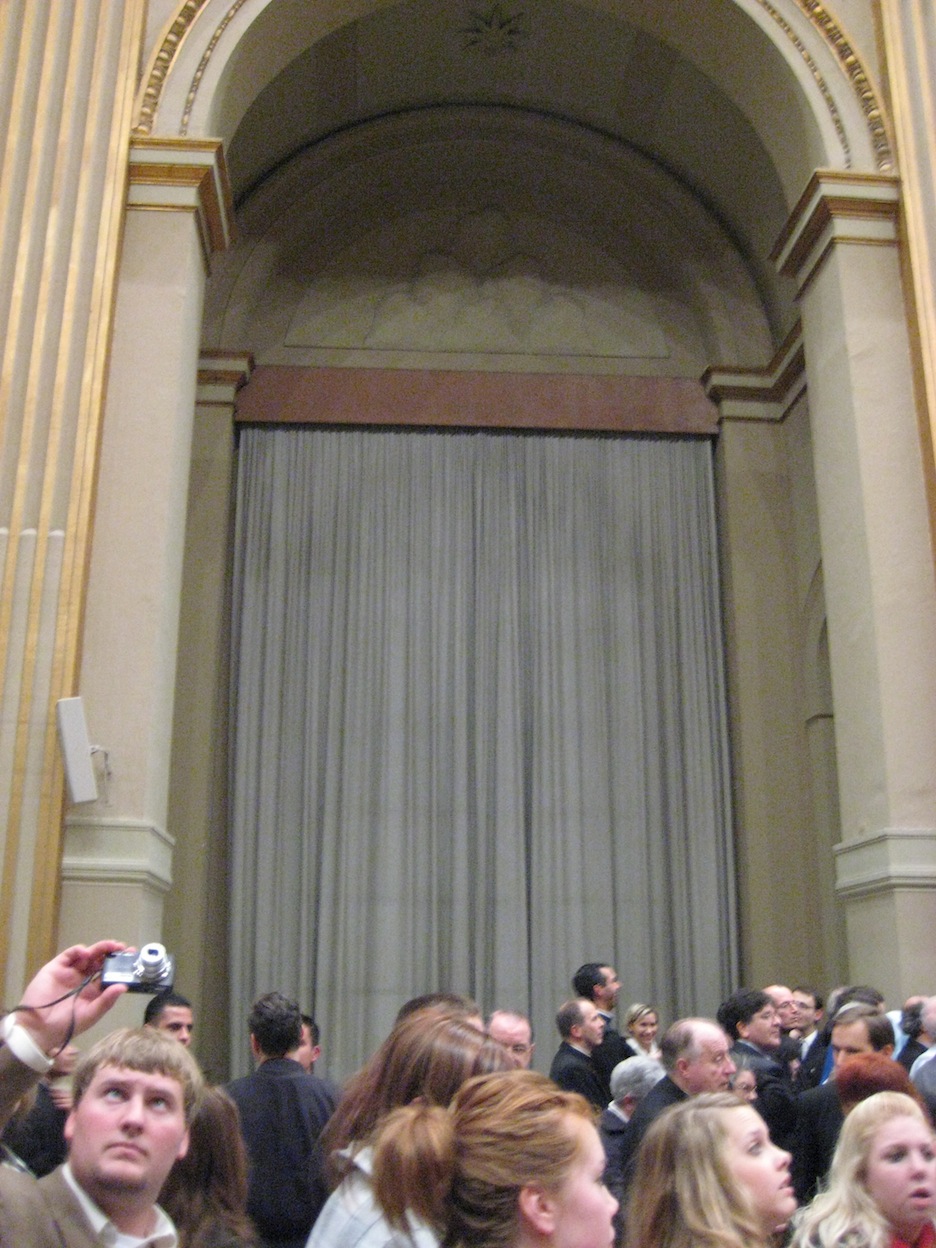 I was honored to serve as a distributor of Holy Communion for the Sunday morning Mass. This particular papal liturgy was marked by the use of a brass quartet who stood in a balcony from the Hall of Blessings which looked into the nave of St. Peter's. While some cautiously lament the use of the brass as a form of a returning triumphalism, I found the honorable instruments to bring a welcome change to the organ-only program of post-Vatican II papal liturgies. I noted later that this same quartet played for Christmas Midnight Mass this year as well.
 One such event is a papal consistory to establish new cardinals. Called for in late October by His Holiness, the November 19 - 21 consistory seemingly grabbed the attention of Rome and thousands of pilgrims who traveled world-wide to see the creation of 24 new cardinals.
Three major events marked the weekend: the consistory itself on Saturday morning, when the 24 cardinal-delegates were elevated to their new rank, a Saturday evening "open house" when pilgrims may enter the Apostolic Palace to greet the new cardinals, and a Sunday Mass during which the Holy Father distributed rings of the office.
Sadly, hundreds were turned away at the security checkpoint for the Saturday morning consistory. St. Peter's Basilica may be monstrously large but it can't hold everyone. I was disappointed but I was especially sad for the pilgrims who had traveled from around the world for this one event.
 A real highlight though was the evening "open house". This is a rare opportunity to see areas of the Vatican that a lowly religious like myself does not normally visit. I was able to greet and meet briefly in the Sala Regia with Cardinal Amato, Prefect of the Congregation for the Causes of Saints, and in the Sala Ducale with Cardinal Burke, Prefect of the Supreme Tribunal of the Apostolic Signatura.
Both men recognized the Holy Cross habit, congratulated me on the recent canonization of St. Andre Bessette, and were very personable. Amato relayed that he remembers fondly his visit to Notre Dame two years ago.
Another utilized room was the Hall of Blessings where the Holy Father on occasion greets various groups. And it is from this large room where the various balconies look out upon St. Peter's Square - including the balcony where the newly elected pope is introduced. And no, I did not hear any "whisperings" while in the room.
 I was honored to serve as a distributor of Holy Communion for the Sunday morning Mass. This particular papal liturgy was marked by the use of a brass quartet who stood in a balcony from the Hall of Blessings which looked into the nave of St. Peter's. While some cautiously lament the use of the brass as a form of a returning triumphalism, I found the honorable instruments to bring a welcome change to the organ-only program of post-Vatican II papal liturgies. I noted later that this same quartet played for Christmas Midnight Mass this year as well.
Wednesday, January 12, 2011
Why!?
 Pima County Deputy Sheriff Kastiger stated today that, "We don't know the why, but we know the what."
That's precisely it. At a conference I recently attended the keynoter boasted that a new telescope - exceedingly more powerful than the Hubble Telescope - is being planned and constructed. And indeed that is certainly a reason to boast.
But scientific revelation does not supplant divine revelation.
The human heart, even when aware of the "what", still hungers for the answer(s) to "why" but it will not be found within ourselves.
As the Holy Father has recently repeated, science can inform us of phenomenon and facts but it cannot inform us of meaning. A modern nation state can have a secular debate but it cannot from within itself derive purposeful meaning. In that realm the polis is infertile. The Church, as steward of and servant to Divine revelation, has an important voice from which ultimate meaning is derived.
An increasingly secular world which spends less and less time pondering the Divine will find itself further lost, grasping with empty hands, when trying to answer "why".
May God grant eternal light to the murdered and may comfort be granted to the other victims and those who mourn.
Subscribe to:
Posts (Atom)